
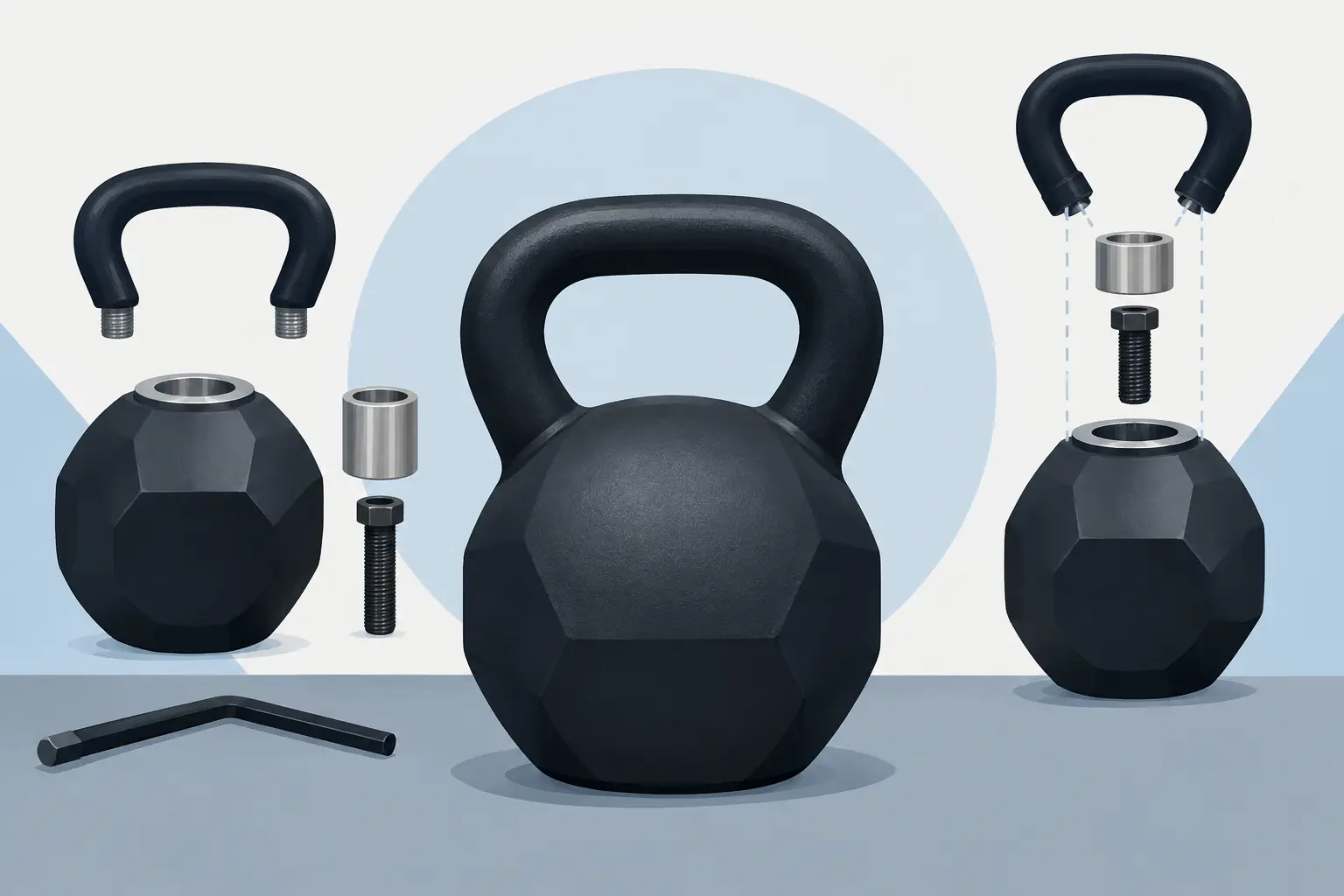
A kettlebell can look indestructible and still be poorly built. A hardstyle kettlebell construction guide starts with that fact. The bell must tolerate repeated swings, cleans, presses, squats, carries, and occasional contact with gym flooring without becoming rough in the hand, unstable on the ground, or unreliable under load.
Hardstyle kettlebells are purpose-built cast-iron tools. Their dimensions usually increase with weight, unlike competition kettlebells that maintain a standardized external size. That makes construction more than a manufacturing detail. It affects grip comfort, rack position, swing mechanics, durability, and how confidently you can earn your reps.
Hardstyle Kettlebell Construction Guide: Start With the Casting
A quality hardstyle kettlebell is normally made as a single-piece cast-iron body. The handle and bell should be part of the same casting, not a separate handle welded onto a hollow body. One-piece construction removes a potential weak point where the handle meets the bell. For ballistic training, that matters.
Casting begins with molten iron poured into a mold. Once cooled, the bell is removed, trimmed, cleaned, machined where needed, and coated. The process sounds simple, but quality depends on control at every stage. Poorly managed casting can leave excess material, sharp mold seams, surface pits, uneven walls, or internal voids.
A smooth-looking finish alone does not prove quality. Paint can hide minor cosmetic flaws. Instead, inspect the areas that take stress: the handle-to-body transitions, the underside of the handle, the bell’s shoulder, and the base. These areas should feel solid and clean, with no cracks, deep pits, or abrupt edges.
Small visual variations are normal in cast iron. This is not precision-machined stainless steel. What you do not want is a bell that feels unfinished, uneven, or compromised at the points where your hand and the load meet.
The Handle Is the Working Surface
The handle determines much of the training experience. A hardstyle kettlebell handle needs enough room for a secure two-hand swing grip while remaining comfortable for cleans, presses, snatches, and racked carries. If it is too narrow, your hands crowd each other during swings. If it is excessively wide, the bell can feel less controlled in single-arm work.
Handle thickness matters just as much. A very thin handle can feel sharp and unstable, especially under heavy load. An overly thick handle can limit smaller hands and make high-repetition work unnecessarily fatiguing. There is no single perfect diameter because hand size, training style, and bell weight all matter. The goal is a rounded, usable grip that supports force transfer without punishing the hands.
Check the underside of the handle carefully. This is where rough seams become obvious during swings and snatches. A quality handle should not have a raised ridge that catches the palm or tears calluses after a few sets. A textured coating can improve grip, but texture is not an excuse for poor finishing.
The handle-to-body window also needs thoughtful proportions. Enough clearance allows the hand to rotate naturally during cleans and snatches. Too little room can force the wrist into an awkward position. More clearance is not automatically better, though. An oversized window can make a smaller bell feel less connected to the forearm in the rack.
Weight Distribution Must Feel Predictable
Hardstyle kettlebells are not designed to be perfectly uniform in dimension across all weights. As load increases, the bell gets larger. That scaling can be useful: heavier bells generally provide a substantial, stable feel for swings, deadlifts, loaded carries, and strength work.
Still, size must be paired with balanced mass distribution. A good bell should not feel as if the weight is pulling sideways through the handle. During a swing, the arc should feel predictable. During a clean, it should rotate around the hand and settle into the rack rather than crash into the forearm.
Balance is especially easy to evaluate with a moderate load. Perform slow deadlifts, controlled swings, and a few clean reps. If the bell tracks consistently and lands in the same rack position rep after rep, its geometry is doing its job. If it twists, rolls unpredictably, or feels noticeably lopsided, do not dismiss it as a technique problem until you inspect the bell.
The flat base is part of that stability. It should allow the kettlebell to sit securely for dead-stop swings, renegade rows, and storage. A badly finished or uneven base can rock on the floor. That is distracting during training and can damage flooring over time.
Coating Is More Than Appearance
A kettlebell coating protects the iron from corrosion and shapes how the handle feels. Common options include powder coating, painted finishes, and other protective surface treatments. Each involves trade-offs.
Powder-coated hardstyle kettlebells are popular because the finish can be durable, controlled, and grippy without needing excessive chalk. A quality powder coat should be even, without thick drips, bare patches, or flakes around the handle and base. A heavily glossy surface may look clean at first, but it can become slick when sweat builds up.
A rougher coating may offer more grip, but too much texture can chew through skin during high-volume snatches or long swing intervals. Serious training requires a finish that works with your hand, not against it. Chalk can help, but it should not be required to compensate for a slippery or poorly finished handle.
The base deserves separate attention. Some bells include a protective treatment that reduces floor wear and noise. This can be useful in home gyms, studios, and facilities with finished floors. The trade-off is that thick base material can wear or peel if it is poorly applied. The best choice depends on your training surface and whether you routinely set the bell down with control.
Surface Finish and Seam Cleanup
Cast iron leaves mold lines. The question is whether those lines have been properly finished. On a well-made hardstyle bell, seams are blended so they do not create hot spots under the hand or along the forearm. You should be able to run your fingers around the handle and shoulder without finding a sharp, raised edge.
Do not expect every bell to be cosmetically identical. Minor texture differences are part of cast-iron production. Focus on functional standards: smooth contact surfaces, a stable base, consistent coating, readable weight markings, and no visible defects that suggest a compromised casting.
Be cautious with bells that have thick, soft-looking paint over obvious irregularities. A cheap finish can chip quickly, expose bare iron, and leave rough edges where the coating breaks down. Surface wear from hard use is normal. Premature flaking around the handle, however, is a sign that the finish was not prepared or applied well.
What to Check Before You Train
You do not need laboratory equipment to make a smart inspection. Set the bell on a level surface and check for rocking. Run your hand around the inside and underside of the handle. Look closely at the handle junctions, base, and any visible seams. Then lift it.
The bell should feel proportionate to its stated weight and stable in a deadlift position. Test a few controlled swings before attempting cleans or snatches. Listen for anything unusual, such as internal movement or rattling. A cast-iron kettlebell should feel like one solid piece of equipment because that is what it should be.
If you are buying several bells, consistency matters. Matching handles, finish quality, and base stability make progression easier in a home gym or coaching environment. A mixed collection can work, but significant differences in handle geometry change the feel of the same movement from one load to another.
Construction Should Match the Job
Hardstyle cast iron is built for direct, repeated strength work. It suits swings, goblet squats, clean and press training, Turkish get-ups, loaded carries, and general athletic conditioning. Its changing dimensions across weights are part of the design, not a defect.
That does not make it the right choice for every athlete or every program. Competition kettlebells maintain the same external dimensions across different weights, which can benefit sport-specific practice and consistent technique through a wider loading range. Hardstyle bells prioritize the traditional cast-iron feel, rugged durability, and a training character that scales physically with the load.
Choose based on the work you plan to do most often. If your goal is durable general strength and conditioning, a well-made hardstyle bell is a serious tool. Incore Sports designs its equipment around that standard: purposeful geometry, dependable materials, and training that holds up beyond the first month.
Your kettlebell does not need to be flashy. It needs to sit flat, grip well, rotate predictably, and take years of work. Inspect the construction, choose the load with discipline, and put the bell to use. Earn your reps.