
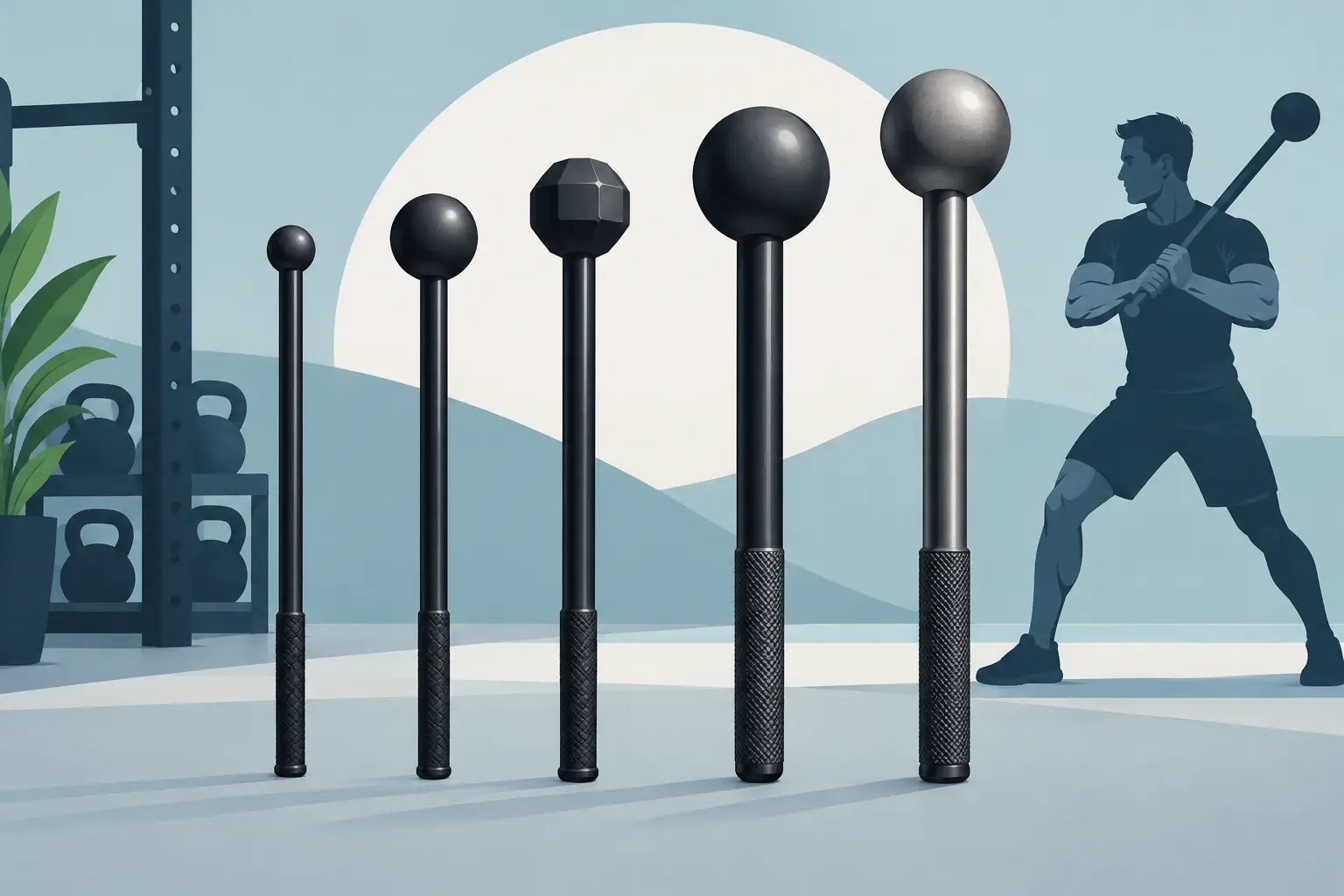
A steel macebell comparison should start with one fact: the number stamped on the head does not tell the whole story. A macebell’s long lever places the load away from your hands, so even a modest weight can demand serious grip strength, shoulder control, and trunk stability. Choose by training purpose and handling characteristics, not ego.
A well-built steel macebell is a direct tool. It develops rotational power, anti-rotation strength, grip endurance, shoulder mobility, and coordination under an offset load. But not every mace feels the same in motion. Length, head shape, handle diameter, finish, and weight distribution all affect whether a mace helps you build clean reps or forces you to fight the tool.
What to Compare in a Steel Macebell
The best macebell is not automatically the heaviest one or the one with the most aggressive appearance. It is the one that matches your current control, your available training space, and the patterns you need to improve.
Fixed-Weight Steel vs. Adjustable Macebells
A fixed-weight steel macebell has one major advantage: consistency. The balance point, total length, and feel remain the same every session. That matters when learning technical movements such as 360s, 10-to-2s, uppercuts, and shield casts. You can track progress through cleaner positions, more controlled volume, slower eccentrics, and eventually a heavier mace.
Fixed steel construction is also durable. There are no plates to loosen, collars to check, or moving parts changing the feel mid-session. For commercial facilities, coaches, and athletes who use a mace repeatedly, this simplicity is valuable.
Adjustable macebells can make sense when storage is limited or when you want many loading options in one tool. The trade-off is balance. Adding or removing plates changes the profile of the head and can shift how the mace moves through an arc. This is less of a concern for basic presses, rows, carries, and lunges. It matters more when practicing flowing rotational work, where consistent timing is part of the skill.
For a dedicated rotational-strength tool, fixed-weight steel usually delivers the more predictable training experience. For a compact home gym with limited equipment, adjustable can be the practical choice. Know which compromise you are making.
Length Changes the Lever
Two macebells can weigh the same and still feel very different. A longer handle moves the mass farther from your hands. That increases leverage and raises the demand on your grip, shoulders, and core. A shorter mace can feel more manageable at the same listed weight because the load stays closer to the body.
Longer models favor broad, powerful arcs and can be excellent for two-handed rotational patterns. They also require more ceiling height and more clearance around the body. Before buying, measure your training area. A mace session in a low basement or crowded garage becomes limited quickly if you cannot safely complete an overhead arc.
Shorter macebells are often easier to control for presses, front-rack work, carries, rows, and single-arm drills. They can be useful for athletes who need an offset-loading tool but do not have room for full 360 practice. Neither format is universally better. The question is whether you are training mace flow, conventional strength patterns, or both.
Head Shape and Weight Distribution
A steel macebell should feel head-heavy. That is the point. Still, the shape and concentration of mass influence the movement.
A compact, dense head tends to create a clear pendulum effect. It moves decisively through the bottom of a swing or cast and rewards good timing. A larger or more extended head may feel slower and more cumbersome, even when the total weight is similar. This can be useful for controlled strength work, but it may be less forgiving while learning dynamic patterns.
Look for a clean transition between the shaft and the weighted end. Poorly proportioned designs can feel awkward in the rack position or interfere with hand placement during hand-to-hand work. The tool should challenge your mechanics, not create needless friction from an impractical shape.
Steel Macebell Comparison: Handle, Grip, and Finish
The handle is where every rep is earned. A macebell handle must let your hands slide and reposition when needed, while still providing enough traction under sweat. Too much texture can tear the hands during volume. Too little texture can force an overgrip, which often leads to forearm fatigue and stiff, inefficient movement.
A medium-diameter handle is the most versatile choice for most trainees. It gives enough surface area for two-handed control and enough challenge to build grip strength without making every set a forearm test. Thicker handles increase grip demand and may suit experienced lifters, but they can make smooth transitions harder for smaller hands or newer users.
Finish matters for durability and feel. Powder-coated steel is common because it resists wear and gives a controlled grip. Smooth painted finishes may allow easier hand movement, but they can become slippery with sweat. Bare or lightly finished steel can develop a distinct texture over time and requires more attention in humid environments.
There is no universal winner. If your sessions emphasize slow presses, carries, squats, and rows, a more secure finish can be useful. If your training centers on repeated 360s and hand transitions, a finish that permits controlled sliding may feel better. Chalk can help, but it should not compensate for a handle finish that does not suit your training.
Weld Quality and Construction
A steel macebell takes repeated impact from acceleration, deceleration, and changes of direction. Construction should be simple and solid. Inspect the junction between the head and shaft, the consistency of the coating, and whether the tool feels balanced when held vertically and horizontally.
A one-piece or securely welded steel design is built for repeated training. Minor cosmetic marks are normal with hard use. Rattling, shifting weight, sharp coating defects, or a loose end cap are not. Specialty tools are meant to be used, but they should not become a maintenance project.
Choosing the Right Starting Weight
Starting weight depends on training history, shoulder health, hand size, and the movements you plan to learn. The right first mace lets you maintain control through the entire range. It should not pull you out of position at the bottom of an arc or force your shoulders forward overhead.
For many beginners, a 7 to 10 lb macebell is enough to learn two-handed patterns. Stronger trainees are often surprised by how demanding a 10 to 15 lb mace can feel during controlled 360s. Strength in the barbell rack, bench press, or deadlift does not automatically transfer to an offset lever moving behind the head.
For single-arm work, reduce the load further. A macebell that feels manageable with two hands can become a different tool when one arm must control rotation, grip, and shoulder position alone. Start with carries, supported rows, presses, and simple pendulum drills before attempting complex single-arm flows.
Do not buy a 25 lb or 30 lb mace as a first tool just because you are strong. Heavy mace training has a place, particularly for carries, squats, rows, and powerful two-handed work. But technical rotational training demands patience. Earn your reps with a load you can decelerate cleanly.
Match the Macebell to the Job
If your priority is rotational power and athletic conditioning, choose a fixed steel macebell with a balanced head, sufficient length for full arcs, and a handle that supports secure transitions. Use it for 360s, 10-to-2s, lunging patterns, and controlled conditioning blocks.
If mobility and shoulder resilience are the focus, start lighter. The goal is not to stretch passively under load. The goal is to actively control shoulder rotation, scapular position, and trunk alignment. Slow halos, offset presses, and light casts can expose restrictions without forcing range you do not own.
If you want strength and grip development, a heavier macebell can work well for presses, rows, deadlifts, squats, carries, and isometric holds. These movements let you load the tool without requiring advanced overhead flow. A macebell does not need to spin around your head to deliver useful training.
For coaches and facilities, consistency is often the deciding factor. A range of fixed-weight steel macebells lets clients progress in small, measurable steps. It also gives coaches a reliable reference point when teaching position, tempo, and volume. Incore Sports approaches specialty equipment this way: purpose first, progression second, novelty never.
A good macebell should make your weak links obvious. Respect that feedback. Begin with clean positions, use enough space, and increase load only when the tool moves under your control. The weight is not the test. Owning every inch of the rep is.