
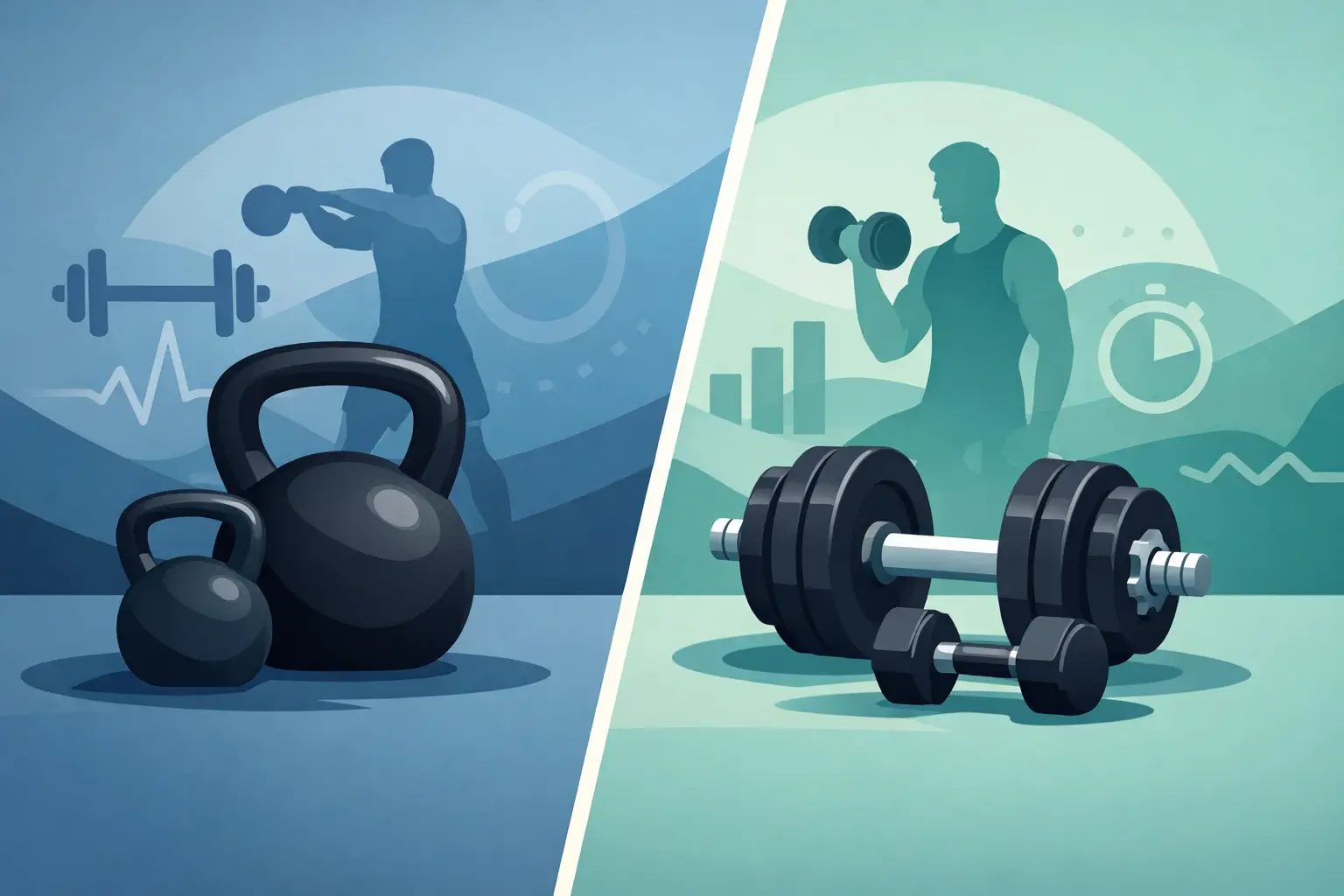
A loaded carry at the end of practice tells the truth quickly. If an athlete cannot keep position while breathing hard, the problem is rarely a lack of exercise variety. It is a gap in strength, control, or work capacity. Kettlebells versus dumbbells for athletes is not a contest with one permanent winner. It is a decision about which tool best exposes and develops the quality a session needs.
Both belong in serious training. Dumbbells make it easier to load bilateral and unilateral strength patterns with precision. Kettlebells reward bracing, grip, timing, and force transfer through movements that do not stop at a clean rep. The best choice depends on the sport, the training age of the athlete, the movement goal, and the point in the season.
Kettlebells Versus Dumbbells for Athletes: The Real Difference
The load sits differently in the hand. That changes the exercise.
A dumbbell places most of its mass evenly on either side of the grip. It feels balanced and predictable. This makes dumbbells highly effective for pressing, rowing, squatting, lunging, and single-leg strength work. An athlete can focus on force production through a familiar movement pattern without spending excessive attention on stabilizing the implement.
A kettlebell carries its mass below and behind the hand. In a rack position, the bell rests against the forearm and sits closer to the athlete's centerline. In a swing, clean, or snatch, its offset center of mass creates momentum that must be directed, absorbed, and controlled. This demands active grip, shoulder packing, trunk stiffness, and clean timing.
That distinction matters when training must transfer beyond the weight room. Most sports require athletes to create force, resist force, and redirect force under changing conditions. Kettlebells often make those demands more visible. Dumbbells make it easier to build the underlying strength that supports them.
When Dumbbells Are the Better Tool
Dumbbells are hard to beat when the goal is straightforward strength development, targeted hypertrophy, or a controlled return from injury. Their balance allows athletes to apply effort without fighting the shape of the weight. That is useful when learning a pattern, rebuilding capacity, or accumulating quality volume.
For example, a dumbbell bench press gives a field athlete a stable way to train horizontal pressing through a large range of motion. A single-arm dumbbell row can load the upper back heavily without the technical learning curve of a ballistic lift. Rear-foot-elevated split squats, step-ups, and lunges are also easy to progress with dumbbells because the loading position is simple and repeatable.
Dumbbells also offer a clearer path when load jumps matter. In a strength block, an athlete may need gradual increases across pressing, pulling, and lower-body accessory work. A full dumbbell set gives coaches many loading options while preserving exercise consistency. This supports measurable progression. Earn your reps, then add load.
For athletes new to resistance training, dumbbells can reduce unnecessary complexity. A beginner who cannot control a bodyweight hinge does not need to learn a heavy kettlebell swing. They need to own a hinge, build leg strength, and learn to brace. Dumbbells help build that base without pretending that every session needs to look athletic.
Where Kettlebells Pull Ahead
Kettlebells become especially valuable when strength must connect to movement. Their shape favors hinge patterns, loaded carries, rack work, overhead stability, and ballistic training. These are not magic qualities. They are practical training demands built into the tool.
The swing is the obvious example. A well-executed kettlebell swing trains powerful hip extension while requiring the athlete to maintain a rigid trunk and lat connection as the bell moves. It is not a squat with the arms lifting the bell. It is a hinge driven by the hips. For athletes who need repeated acceleration, jumping power, or conditioning without high-impact running volume, that can be useful.
Cleans and snatches add another layer. The athlete must produce force, guide the bell efficiently, and receive it in a secure rack or overhead position. Poor technique gets punished quickly through banging on the forearm, a loose shoulder, or a loss of posture. Good technique teaches force control.
Kettlebell carries deserve equal attention. A suitcase carry challenges lateral trunk stability and grip. A front-rack carry trains breathing and posture under anterior load. An overhead carry exposes gaps in shoulder stability and rib control. These are simple movements, but they are not easy. They build the kind of durable strength athletes can use late in a game, round, or race.
Power Training Is Not Just About Moving Fast
Athletes often choose kettlebells because they want power. That makes sense, but only when the load and skill match the goal. A heavy bell moved slowly is strength work. A light bell moved without tension is just motion. Productive ballistic work sits between those extremes: enough load to demand force, enough speed to maintain intent, and enough technical control to protect position.
Dumbbells can also train power. Dumbbell jump squats, push presses, high pulls, and split-stance presses can fit well in athletic programs. Their balanced design may make them easier for some athletes to learn, particularly in unilateral work. A pair of dumbbells also allows symmetrical loading for jumps and presses.
Kettlebells usually have the advantage in cyclical ballistic work. Swings, cleans, and snatches let an athlete link repetitions efficiently while managing momentum. That makes them effective for power endurance and conditioning sessions. The trade-off is technical demand. A coach should not prescribe high-rep snatches to an athlete who cannot maintain a stable overhead lockout.
Mobility, Stability, and Position
Neither tool creates mobility by itself. Mobility improves when an athlete can actively control a useful range of motion under appropriate load. Kettlebells can be particularly effective here because rack, bottoms-up, and overhead positions require active shoulder and trunk control.
A bottoms-up press is a clear example. The unstable bell demands a firm grip, organized wrist, engaged rotator cuff, and disciplined pressing path. It is not a maximal-strength lift. It is a position drill with load. Used conservatively, it can sharpen shoulder stability for athletes who already have enough basic pressing strength.
Dumbbells offer their own mobility benefits. A dumbbell goblet squat can help an athlete counterbalance into a deeper squat while learning to keep the torso organized. Dumbbell Romanian deadlifts allow a controlled hamstring lengthening pattern. Single-arm presses can reveal side-to-side differences without the more demanding wrist and rack position of a kettlebell.
The rule is simple: use the tool that lets the athlete own the position. Do not force a kettlebell rack on a player with limited wrist extension and poor thoracic control when a dumbbell variation produces better training today.
Equipment Choice by Training Goal
For maximum or near-maximum strength, dumbbells are often the cleaner option, especially for presses, rows, split squats, and accessory work. Their predictable balance supports hard loading and repeatable reps.
For hip power, carries, trunk control, and dense conditioning, kettlebells often deliver more in less time. A session built around swings, front-rack squats, carries, and controlled get-up work can train several athletic qualities without turning into random fatigue.
For unilateral training, both tools work. A dumbbell may be easier to load heavily in a split squat or row. A single kettlebell in the rack can challenge the trunk more aggressively during squats, reverse lunges, and carries. Choose based on the limitation you want to address, not on which implement looks more advanced.
For home training, kettlebells can be extremely space-efficient. A few well-chosen bells cover swings, squats, presses, rows, carries, and conditioning. Dumbbells become more versatile as the available weight range expands. Adjustable dumbbells can solve the space issue, though they are not always ideal for fast or ballistic work.
Competition or Hardstyle Kettlebells?
Athletes who train cleans, snatches, and long-cycle work regularly often benefit from competition kettlebells. Their dimensions stay standardized as weight increases, so the rack position, handle window, and hand placement remain consistent. This matters when technique and repeatable volume are priorities.
Hardstyle cast-iron kettlebells suit general strength, swings, carries, goblet squats, and rugged day-to-day training. Their physical dimensions typically change with weight, which is not a problem for most athletes. The key is durable construction, a handle that fits the intended grip, and a load that supports clean execution.
Do not buy a 32 kg kettlebell as a first bell because it sounds serious. Serious training is selecting a weight you can control, then progressing without shortcuts.
Build the Session Around the Athlete
The strongest programs do not choose sides. A basketball player might use dumbbell split squats and rows to build single-leg and upper-back strength, then finish with kettlebell swings and suitcase carries for hip power and trunk control. A combat athlete may use dumbbell pressing for volume, kettlebell rack carries for posture, and kettlebell cleans for conditioning. A sprinter may need very little high-rep ballistic work during a demanding competition period, even if kettlebells are available.
Training age matters as much as sport. Give beginners enough repetition with basic strength patterns. Give advanced athletes the tools that match a specific performance need. Keep the exercise menu focused. Progress load, density, range, or complexity one variable at a time.
Pick dumbbells when you need stable loading and direct strength work. Pick kettlebells when you need force transfer, carries, hinge power, and disciplined movement under momentum. Then train the choice hard enough to make it count. The tool does not earn the rep. The athlete does.