
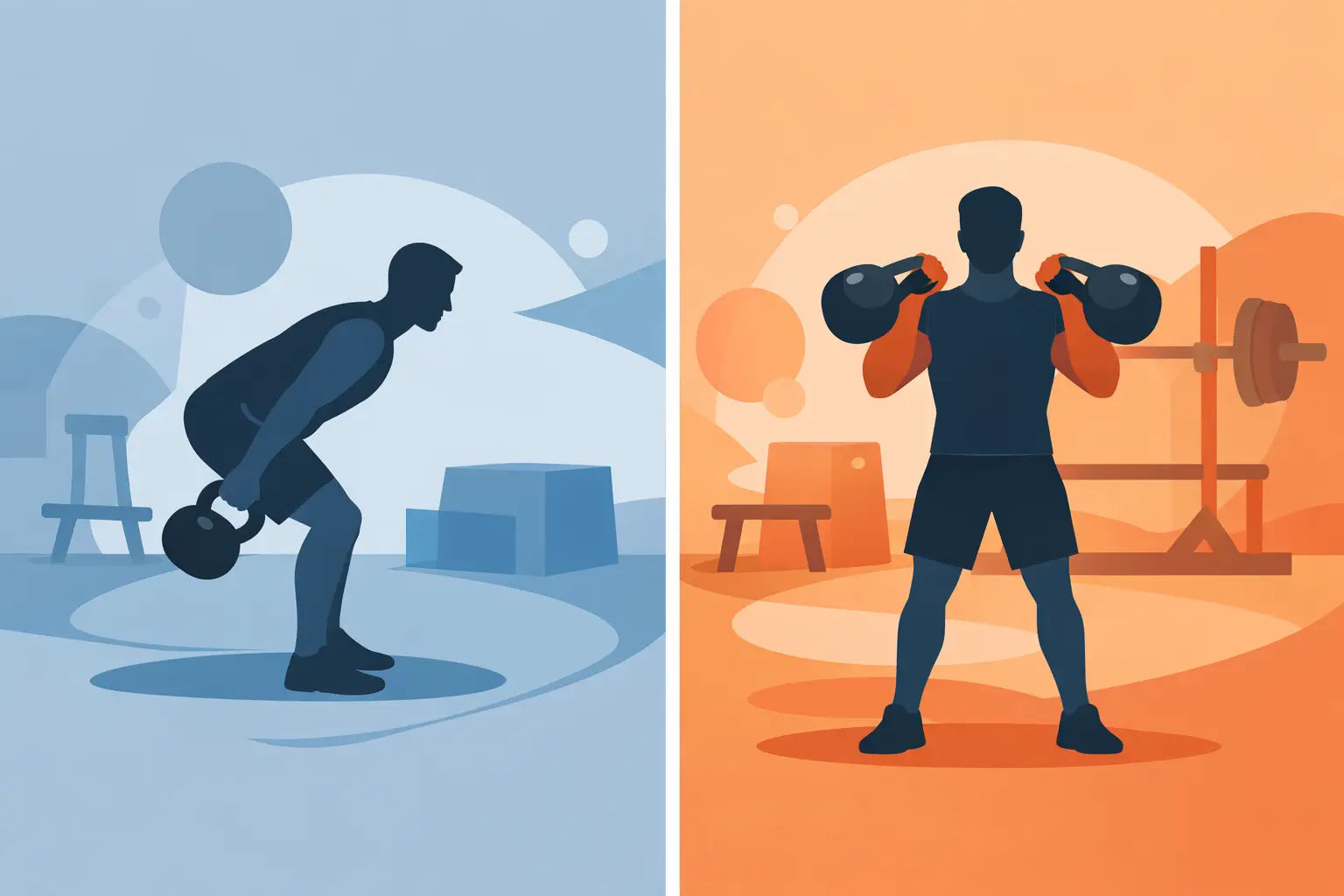
A clean single-bell swing can build the engine for serious training. A pair of bells can expose every weak link in your rack, brace, and leg drive. That is the real question in single versus double kettlebells: not which option is harder, but which one gives your current training the right demand.
Neither setup is automatically better. Single-bell work gives you asymmetrical loading, unilateral strength, and room to learn the fundamentals. Double-bell work raises total load, requires tighter positioning, and develops a different kind of whole-body strength. Choose based on your skill, goal, and the equipment you can progress with consistently.
What Changes With One Bell and Two
A single kettlebell sits to one side of the body. Your trunk must resist rotation and side bending while you move the load. In a press, squat, carry, or clean, the unloaded side has work to do too. It must help keep your rib cage stacked over your pelvis and prevent the bell from pulling you out of position.
This makes a single bell highly useful for building control. It also makes technical practice less intimidating. You can focus on one clean landing in the rack, one arm path on the press, and one-sided hip drive on the swing. If the movement breaks down, the correction is usually clear.
Two kettlebells change the equation. The load is balanced from left to right, but the total demand rises fast. Double front squats, cleans, and presses require a strong brace, efficient breathing, and enough upper-back strength to maintain two stable rack positions. There is less room to shift, twist, or compensate.
The double rack is especially revealing. If your elbows drift, wrists collapse, or ribs flare, two bells will let you know immediately. That feedback is valuable, but only when you have the mobility and technique to use it well.
Single Versus Double Kettlebells for Strength
For absolute strength, doubles usually offer the higher ceiling. Two bells allow more total loading in bilateral patterns without moving straight to a barbell. Double front squats can load the legs hard while demanding a vertical torso. Double presses build shoulder strength when the rack and lockout are earned, not forced.
But heavier is not always more productive. A single kettlebell can create substantial strength through unilateral loading, longer ranges of motion, pauses, slow eccentrics, and carries. A heavy one-arm press or front-rack reverse lunge asks for strength that does not hide behind the stronger side.
Think in terms of the pattern you need. If your goal is to strengthen one side, improve anti-rotation, or build a stable overhead position, a single bell has a clear advantage. If your goal is to develop a stronger squat, clean, or press with greater total load, doubles are often the better tool.
For athletes, the answer often includes both. Single-bell work can build control through offset carries, lunges, and presses. Double-bell work can build force production and work capacity through squats, cleans, and push presses. Use the tool that addresses the gap, not the one that simply feels more impressive.
Technique Comes Before Pairing Bells
A matched pair does not make a movement twice as difficult. In some ways, the symmetrical load can feel more predictable than a single bell. The challenge is that double kettlebells demand both sides perform at the same time, under more load, with less margin for error.
Before moving into double cleans, you should be able to hinge sharply with a single bell, keep your shoulders packed, and guide the bell into a quiet rack. Before double presses, own a single strict press without leaning back or turning the rep into a side bend. Before double front squats, maintain a stacked torso and full-foot pressure with one bell in the rack.
Do not rush this process. Repeatedly catching two bells on the forearms with poor timing is not a toughness test. It is a fast route to bruising, irritated wrists, and sloppy mechanics. Earn your reps with single-bell skill, then let doubles raise the standard.
The rack position decides a lot
A strong rack is the bridge between single and double training. The bell should rest close to the body, with the wrist neutral enough to support the load and the elbow connected to the torso. Your ribs stay down. Your breathing remains controlled.
With one bell, you can often find the rack while managing small imperfections. With two, those imperfections multiply. Spend time on front-rack holds, marches, and squats before chasing high-rep double complexes.
Conditioning: Different Stress, Different Result
Single-bell conditioning is flexible. You can switch hands during swings, cycle snatches, use alternating cleans, or combine carries with bodyweight work. The offset load challenges grip and trunk endurance without requiring two identical bells. It works well in small spaces and in sessions where technique practice matters as much as fatigue.
Double-bell conditioning is denser. A set of double cleans and front squats can elevate your heart rate quickly because both bells move at once. Complexes built around clean, squat, press, and rack carry patterns deliver a hard strength-conditioning session without a lot of exercise changes.
That density has a cost. When fatigue rises, double-bell form can deteriorate faster than single-bell form. Keep the reps crisp. A short set of quality double cleans is better than a long set that turns into a loose swing and a hard forearm crash.
If you are new to kettlebells, build conditioning with simple swings, goblet squats, carries, and presses first. Conditioning should not become a reason to practice bad technique faster.
Equipment Decisions That Matter
A single bell is the most practical starting point for most home trainees. It costs less, takes less space, and supports a wide range of foundational training. You can swing, squat, clean, press, row, carry, and lunge with one quality kettlebell.
A pair becomes valuable when your technique and goals call for it. For double work, use matched kettlebells of the same weight, dimensions, and handle shape. Mismatched bells can be useful for advanced offset training, but they are not the right starting point for learning double cleans or presses.
Competition kettlebells are a strong choice for lifters who want standardized dimensions as weight increases. The bell body and handle stay consistent across the range, which can make progression in rack work, pressing, and long-cycle style training more predictable. Hardstyle cast-iron kettlebells suit durable general strength training and offer the familiar feel many lifters prefer for swings, carries, and foundational work.
Handle comfort matters in both cases. With doubles, it matters even more because the bells must sit cleanly beside each other in the rack. A handle that works for occasional swings may not feel right during repeated cleans or front squats. Train with equipment built for repeated use, not novelty workouts.
A Practical Progression Path
Start with one bell if you are learning the hinge, clean, squat, and press. Build clean sets of swings, goblet squats, one-arm presses, and carries. Increase volume gradually, then increase load when your positions remain sharp.
When you can control a single bell in the rack and overhead, introduce a lighter matched pair. Begin with double rack holds, marches, and front squats. Add double deadlifts and controlled cleans. Pressing can come later, once you can keep both bells stable without rib flare or a backward lean.
There is no rule that says every session must use doubles once you own them. Keep single-bell work in the program. It preserves unilateral strength, exposes asymmetries, and gives your joints a different training stimulus. A well-built plan may use doubles for heavy squats and cleans, then singles for presses, carries, and rotational control.
The right choice is the one you can load with discipline. Start where your technique is honest. Add the second bell when your positions can support it. Then keep showing up, keep the reps clean, and earn the strength that heavier kettlebells demand.